The Visit Is 15 Minutes. The Plan Happens in Between.
Physician and former New Jersey Health Commissioner Dr. Kaitlan Baston on leaving healthcare better than she found it, and why she built Vinyl.

I’m a doctor, so I’m constantly the person helping interpret. I’m on the batphone.
A friend’s mom came home from the hospital with nine new prescriptions. I got the call. A colleague heard the word “cancer” and nothing after it. I got the call. A friend’s son was early in addiction recovery and heading to the ER, scared he’d be treated like a suspect. I got the call.
Someone has to go to the hospital. Someone gets told they need a thing and wants to know, do I really need this? Those calls were never really about bad medicine. The doctors were good. The calls were about the space between visits, where nobody was holding the whole picture except a scared person and whoever they could get on the phone.
People need access to the comfort doctor friends can provide even if they don’t have me in their pocket. Everyone deserves that. That’s why we built Vinyl.
Leave it better than I found it
I’m a doctor. I’m a mom. I’m a person. And I learned early on as a primary care doctor that I couldn’t work in this system without working on this system. My whole career I’ve been driven to leave healthcare better than I found it. My whole life, really.
It started in rural Appalachia, in Southeast Ohio, watching kids get on the school bus without clothes or shoes that fit them. I saw poverty every day, and I learned that the opposite of poverty isn’t wealth. It’s health. It grew in medical school in inner city Philadelphia, where I saw life threatening gaps in care up close. And it got a lot sharper doing maternity care in Rwanda and the Dominican Republic, where I learned what a real lack of access means.
Since then I’ve been a primary care doc and an addiction doc. I started the Center for Healing at Cooper in Camden. I served as New Jersey’s Commissioner of Health. I ran University Hospital in Newark, a Level 1 trauma center and the state’s only public acute care hospital.
And from every one of those seats I watched the same thing happen. In government, as a provider, running a hospital, I kept saying it. Everybody’s trying to coordinate care. Government pays for care coordinators. Payers pay for care coordinators. Providers hire case managers. Everybody is coordinating for their own purposes, and we rarely involve patients and families and let it come from them. Not because there aren’t great care coordinators out there. There are. We’re duplicating efforts, and nobody has the tools to see the whole picture.
The visit is 15 minutes
The appointment is short and packed. Then the patient walks out the door and the real work starts. Pick up the right prescription. Remember which dose changed. Tell the next specialist what the last one said. Explain all of it again to a sister who couldn’t come.
The visit is 15 minutes. The plan happens in between. And in between, we all have lives. I’m a working mom. I’ve got 20,000 things I’m trying to keep straight, and healthcare is part of what I think about, but not 100% of the time. Nobody’s is.
We built a healthcare system that keeps careful records of events. This admission. That appointment. This lab. We never built a record of a person. Each doctor holds a piece. Put it all together and it’s a giant junk drawer. The only one at every single visit is the patient.
And we ask the most of patients at their hardest moments. The day of a new diagnosis. The morning of a discharge. The first weeks with a newborn. I call it the Advocacy Paradox. The less able you are to speak up for yourself, the more the system needs you to.
This isn’t a story about bad doctors. Clinicians are stuck in the same broken filing system and usually can’t see what they’re missing. It’s a design problem. And design problems can be fixed.
What we built
Healthcare should be designed for the people we serve. Patients and their families often know what they need. When they don’t, they deserve to have every tool at their fingertips to find out.
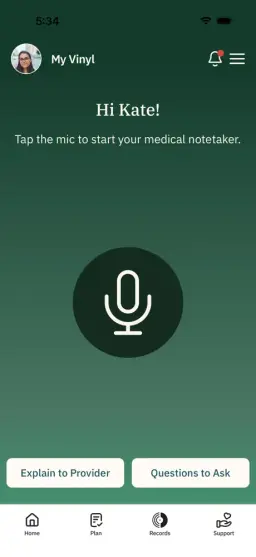
So we built Vinyl. It uses all the big technology buzzwords, ambient AI, record integration, but it points all of it at patients and their families. With your doctor’s okay it records your visit and turns it into plain language notes and next steps. It can do the same for a visit with a doula, which would otherwise never make it into a health record, or for the big pre-op visit with a dozen check boxes you need to get done so you don’t miss your surgery. The audio never leaves your phone. Only the written summary is saved. It keeps one list of your medications and care plans across every doctor you see. And you decide who else sees it. Your daughter. Your care manager. Your next doctor. Hence the name. Vinyl. Your platinum record.
You’re the CEO of your body. Your doctors are your expert consultants. Everyone deserves a personal health assistant, and I’m so happy we get to make that possible for everyone, not just the people who happen to know a doctor. It builds autonomy and community at the same time. Vinyl doesn’t fix everything. But it’s a damn good start.
Why now
Earlier this month I got to present and learn from healthcare leaders at Upstream in Columbus. In my home state! It was, no joke, one of the best conferences I have attended. Small enough to have real conversations and cross industry enough to make connections that mean real change. My panel blew me away. Bipartisan and brilliant, with two physician legislators who went deep on the financial incentives driving the outcomes we see today. I left with more ideas than I came with, which is always the best kind of day. Patients are showing up with AI answers. Families are exhausted. Clinicians want more time with their patients. Everyone agrees the gaps are real.
My first mentor used to tell me to go home at 6:00. “Remember, it’s a marathon, not a sprint. This work isn’t going anywhere.” Good advice. My two daughters remind me of it every day. But there’s a fire in me that makes it hard to wait, and I’m so grateful to be building this with the team at Vinyl.
The stories I hear at events like that are exactly why I was motivated to run a startup. At Vinyl Health I get to be nimble, to push on the system, and to build something that makes healthcare work the way it is supposed to for people. If you’ve ever been the person on the batphone, or needed one, I would love to hear from you. You can find me on LinkedIn.
Dr. Kaitlan Baston is board certified in family medicine and addiction medicine. She is the former New Jersey Commissioner of Health and the founder and CEO of Vinyl Health.
Try Vinyl’s Notetaker
Record your visit and get a plain language summary and next steps in your app. The audio never leaves your phone.
Get the app