National Family Caregivers Month: 30 Small Things That Actually Help
November is National Family Caregivers Month. Skip the candle. 30 small, specific things that help a caregiver you know, or help you if you’re the one.

Last reviewed November 2026. Medically reviewed by Dr. Kaitlan Baston, MD, MSc.
November is National Family Caregivers Month. You’ll see posts thanking caregivers for their strength. Nice. Not useful. The caregiver you know doesn’t need to be called a hero. She needs someone to take her dad to cardiology on Tuesday so she can make her kid’s recital.
AARP and the National Alliance for Caregiving count about 63 million family caregivers in the U.S. Most have jobs. One study of employed caregivers found 23 percent reported missing work or working while distracted in a given month. So here are 30 small things. Ten if you know a caregiver. Ten if you are one. Ten for the family. All of them help. Pick three.
If you know a caregiver
- Offer a task, not a favor. “I can drive Thursday or Saturday. Which?” beats “let me know if you need anything” every time.
- Take the pharmacy run. It’s 45 minutes she gets back and it requires no medical knowledge. Or, recommend an app like Vinyl where she can request the specific support she needs, and you can simply sign up.
- Sit with the parent for two hours. Bring cards. She gets a haircut or a nap.
- Bring food that doesn’t need a dish returned. The return trip is one more task.
- Text or post without a question in it. “Thinking of you. No need to reply.” Then don’t expect a reply.
- Learn one doctor’s name. Then you can ask “how did the visit with Dr. Chen go?” instead of “how’s your dad?”
- Take her kid somewhere. The kids of caregivers lose the most invisible hours.
- Make the insurance call. Hold music is the same from any phone. Ask what to say and sit on hold for her.
- Show up on the boring day. Everyone comes for the hospital. Nobody comes for week six.
- Ask what she’d do with three free hours. Then make the three hours happen.
If you are the caregiver
- Write down what’s in your head. Doctors. Doses. Passwords. One page or one app. If you got the flu tomorrow someone should be able to find it.
- Pick a backup. One sibling or friend who can see everything and act. In Vinyl that’s a Care Partner. You and the person you are caring for can choose who and add them before the emergency happens.
- Post tasks instead of waiting. Dates and jobs. People claim what they can. Ask for Support in Vinyl shows each one as open or covered.
- Set an update rhythm. Every Sunday. The “any news?” texts can finally stop because people know news is coming. Or, use an app designed to keep people updated in one place so you don’t have to manage multiple text threads.
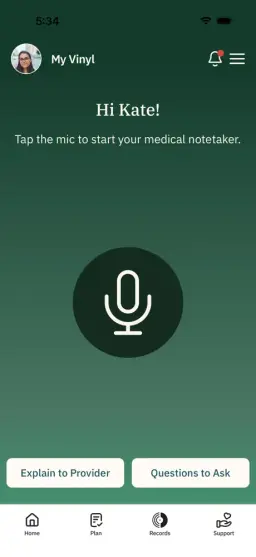
- Ask to record the next visit. With the doctor’s okay. The audio never leaves your phone. Only the written summary is saved. You stop being the only memory in the room. Not sure what’s allowed where you live? Start with our state by state guide.
- Book your own appointment. The one you’ve moved three times. Caregivers are allowed to be patients.
- Say no to one thing this month. The bake sale. The committee. Something.
- Let your parent do what they can. Posting their own update is good for both of you.
- Eat sitting down once a day. We’re not kidding. Standing at the counter doesn’t count.
- Tell your manager the shape of it. Two visits a month. Usually Tuesdays. A plan gets more flexibility than a crisis. Our guide to caregiving while working full time has the script.
For the family
- Hold one meeting. Thirty minutes. Who does what. Write it down. Our post on the 11 p.m. sibling group chat has the agenda.
- Split by skill, not by distance. The sibling in Denver can call insurance. The one nearby can drive. Both count.
- Give the far away sibling a real job. Updates. Bills. Research. Something with a deadline. Keep them in the loop with tasks on an app.
- Agree on who sees what. Updates for most people. Records for one or two. You decide who sees what.
- Pay for help if you can. A few hours of home care a week is cheaper than one sibling quitting a job.
- Say thank you with a date on it. “I’ve got Dad the weekend of the 21st” beats “we appreciate you.”
- Don’t critique from a distance. If you want a say in the plan, take a shift.
- Check on the caregiver’s own health. Ask when she last saw her own doctor. Then drive her.
- Plan the holidays now. Who hosts. Who brings Dad. Who covers the morning meds.
- Review in January. Roles that made sense in March may not fit in December. Meet again.
One honest note about National Family Caregivers Month
We make a caregiving app, so you’d expect us to say download it. Do if it helps. Vinyl is free. But most of these 30 things need no software. They need a person to pick one and do it this week. The app just makes it easier to see which ones are covered.
FAQ
When is National Family Caregivers Month?
November. It’s recognized every year by presidential proclamation and led by the Caregiver Action Network.
What is the best way to help a family caregiver?
Take a specific task off her list. A ride. A pharmacy run. Two hours with the parent. Specific beats general every time.
How do I ask for help as a caregiver without feeling guilty?
Post the task with a date. You’re not asking for a favor. You’re letting people who already want to help know what would help.
Sources
- AARP and National Alliance for Caregiving. Caregiving in the US 2025.
- Keita Fakeye MB, et al. Caregiving related work productivity loss among employed family and other unpaid caregivers of older adults. Value Health. 2023;26(5):712 to 720.
- Caregiver Action Network. National Family Caregivers Month.
Try Vinyl’s Notetaker
Record your visit and get a plain language summary and next steps in your app. The audio never leaves your phone.
Get the app